 Kendra Lusty
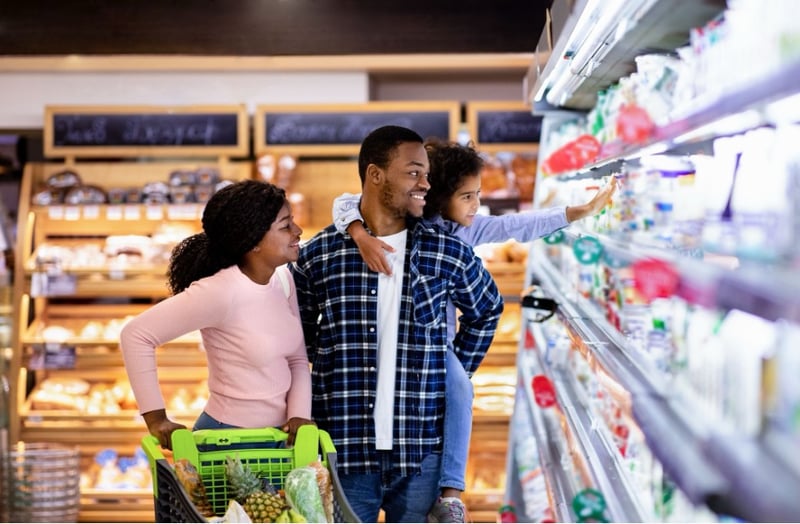
My youngest daughter loves grocery shopping with me, but only at the local small-town grocery store. She’ll choose shopping over the park, over the library, and over going to grandma’s house.
Why? It has miniature shopping carts she can push and fill all by herself. It sells $.49 ice cream cones that are so big and so cheap, I rarely say no. The checkers give her suckers and compliment her for being “mom’s big helper.”
By contrast, we only have to pull up to the big box store down the road to set off an hour-long tantrum.
Prices are higher at the local grocer. Even so, most weeks I will choose to shop there just for the benefit of having a peaceful shopping experience.
Grocers sell some of the most interchangeable products on Earth. Milk is milk. Bread is bread. Who cares where you get it from? No wonder there are so many diverse reasons people choose where to shop: sales, proximity, kid-friendliness, etc.
It’s also no wonder that grocers helped invent loyalty programs as we know them. The grocery loyalty playbook forges a path for businesses of all types to convince their customers to choose their business over the competition. Supermarkets have run their loyalty programs in public for decades, sharing their successes with organizations of all kinds.
In this article, we outline seven strategies commonly used by grocers. Though they have different products, audiences and needs, associations and membership organizations can benefit from implementing loyalty strategies designed to engage some of the most fickle customers in the world.
Key takeaways
- Grocers helped invent and perfect loyalty programs, so their playbook is worth borrowing.
- Show members their savings at the moment they spend, not just at renewal.
- Use member behavior to spot who is drifting before the renewal notice goes out.
- Small, frequent perks build habits that big annual benefits can’t.
- Early access and recognition are among the cheapest and most valued benefits you can offer.
- Recognize members the same way across every channel they use.
- Add a premium tier only after the base membership clearly proves its value.
- Partner for benefits you can’t build yourself, but keep your brand on the experience.

Why Look to Grocery Brand Loyalty Programs for Member Engagement Lessons?
Grocery brand loyalty programs have been running longer, at bigger scale, and with less product differentiation than most other programs.
Reason #1: Grocery stores helped invent loyalty programs.
In 1793, a New England merchant became the first to incentivize repeat business, by giving out copper coins which customers could redeem for merchandise on future visits. The idea caught hold and spread. A century later, many grocers and other retailers signed up to distribute collectible stamps which could be redeemed for goods from the S&H catalog, a pioneer LaaS (loyalty as a service) program. These examples are some of the first recorded loyalty programs in the world.1
Reason #2: Grocery stores have tried it all.
Since those early attempts, businesses of all kinds have continued to push the envelope, developing newer, more creative brand loyalty programs. All have the same goal: convince customers to choose your business over the competition. The methods are as varied as the companies running them, but nearly every idea in modern loyalty programs, from points to personalization to member-only pricing, has been tested at a checkout lane first.
Reason #3: Grocery loyalty has reached a scale few other programs can match.
In the UK, 97% of shoppers belong to at least one supermarket loyalty scheme and the average shopper belongs to 3.2 One prominent grocer, Kroger, reported $147.6 billion in total sales last year,3 with more than 95% of customer transactions tied to a Kroger loyalty card.4 That makes these programs some of the most widely used, most closely studied experiments in loyalty anywhere.
Reason #4: Grocery programs inspire loyalty against the odds.
If a grocery program can make shoppers care where they buy eggs, the lessons should carry over to an organization selling something far more distinctive, like professional community, credentials, or advocacy. At the same time, near universal membership has made these programs easy to take for granted. Membership organizations often battle against indifference and oversaturation.
In the US in particular, people love loyalty programs. However, the more programs they belong to, the less engaged and loyal they are.5
Why is this a particular problem in 2026? The competition is only growing, with more (and more sophisticated) loyalty programs available to steal away pieces of your audience’s attention.
7 Grocery Loyalty Program Examples Reveal Winning Strategies for Associations
Grocers have spent more than a century figuring out how to win customers who could easily shop somewhere else.
Membership organizations face the same challenge every renewal season. The good news is that you don’t need Kroger’s budget or a team of data scientists to borrow what works. Below, we outline nine successful strategies used by grocers today, demonstrated by real world loyalty program examples. Then, we demonstrate how associations and membership organizations can use each one to win their members’ loyalty. Their playbook shares a lot with the best loyalty programs across industries.
1. Show members their savings at the moment they spend.
If members can't see the value, it might as well not exist. The most effective loyalty programs put the benefit in front of the customer at the exact moment they pay.
Tesco’s Member Pricing Strategy: Tesco Clubcard started decades ago as a points program. Then, as customers grew more price and value-focused, the program introduced Clubcard Prices in 2020.6 Member-only prices are displayed on the shelf tag, right next to the regular price. By its 2025/26 results, Tesco was running more than 10,000 Clubcard Prices,7 and the program reaches over 23 million households.8
From the shopper’s point of view, being a member means scanning their card and seeing an immediate price drop in the checkout line. The amount they saved is printed on the receipt, along with a running total of their savings this year. Immediate, tangible proof of value. The result? Use of the loyalty program increased so that now 84% of Tesco’s sales run through a Clubcard.8
What Associations Should Copy: If your member pricing only appears on a single webpage or flyer (as it does for many organizations), then borrow the shelf tag method to bring the benefit front and center.
- Show member and non-member prices side by side everywhere they apply: event registration, certification exams, publications, and partner discounts.
- Confirm the savings at checkout ("As a member, you saved $240 on this registration").
- Total a member's savings for the year on the renewal notice, so the invoice arrives with its own receipt.
2. Use your loyalty program data to learn which members are about to leave.
Ever hear the phrase “actions speak louder than words”? What members do tells you more than what they say on a survey. The best loyalty programs treat every interaction as a signal, and use those signals to spot who is drifting before the renewal notice goes out.
Kroger’s Data Strategy: Kroger has built one of the largest versions of this in American retail. More than 95% of its customer transactions are tied to a loyalty card,4 which means nearly every purchase is attached to a household (63 million of them). That data runs through Kroger's own data science company,9 where it shapes personalized offers, merchandising decisions, and gives insight into customer motivations.
Customers don’t have to do anything special to see the benefits. Their own shopping habits, revealed over time, lead to better, more personalized deals, messaging, and reasons to stay.
What Associations Should Copy: Even without an entire data science subsidiary, associations can collect and use behavioral data on a smaller scale. Website logins, event registrations, email opens, deal redemptions, certification progress, committee roles, etc. are all trackable and can lend valuable insights into member behavior.
- Find the two or three behaviors that best predict renewal. If members who attend two events renew far more often than those who attend one, your second-event invitation is your most important retention email.
- Flag members whose activity drops and reach out before renewal, not after it lapses.
- Use aggregated, consented insight into member interests to make sponsor packages more valuable. That's the association version of retail media.
3. Give members one small perk they use every week: the power of small, frequent wins
A small perk members use often builds habits in a way big annual benefits can't. For one thing, there’s no time in between usage to forget it exists. Also, perks that have become a natural and beneficial part of one’s life are harder to say goodbye to than ones only useful intermittently.
Waitrose’s Freebie Strategy: Waitrose, the upscale UK grocer, has never had a points program. Instead, My Waitrose’s signature benefit is a free hot drink for members. Paused during the pandemic, it was relaunched after and quickly grew past pre-pandemic popularity, serving 240,000 drinks per week (12% higher).10 As active members continued to grow,11 Waitrose expanded their freebie perks lineup with Little Treats in 2025.12
Not all shoppers will take advantage of a small perk, but those who do tend to make it part of their preferred routine. When a company or organization is attached to a routine, it stays top-of-mind.
What Associations Should Copy: Frequency builds habit, and habit is hard to cancel. If your organization’s value centers on one big annual event, or on static benefits members forget about, try the small, frequent value method.
- Add a small, recurring, members-only perk: a monthly resource drop, a standing coffee-bar discount at your conference, or first access to event registration.
- Add members-only discounts for items related to your organization, and/or on everyday purchases that members would have made anyway.
- Favor frequency over size in communication too. Many small reminders of membership beat one large one.
4. Reward loyalty with access and recognition: what the best loyalty programs have in common
Customers want preferential treatment nearly as much as they want discounts. The best loyalty programs make members feel recognized. Bonus: recognition is one of the cheapest benefits an organization can offer. In fact, “access” (defined as first looks, last calls, and front-of-the-line treatment) was the top loyalty driver in both 2025 and 2026.13
Costco’s Exclusive Access Strategy: In 2025, Costco added exclusive shopping hours for its Executive members, who pay an extra $65 a year on top of the standard U.S. membership. Before regular members arrive, executive members get the aisles to themselves. According to Costco's annual report, Executive members made up less than half of all paid members, yet accounted for roughly 73.6% of worldwide net sales that year.14
The early hour tells its best customers, in the most visible way possible, that they come first.
What Associations Should Copy: Each instance of recognition offers another reason for members to stay and associations can offer this kind of recognition without buying a single thing:
- Open event ticket sales to members before the public, and to long-tenured members before everyone else.
- A dedicated line of communication for long-time or high-tier members, including faster customer service or opportunities to meet CEOs, keynote speakers, industry celebrities, etc.
- Recognize tenure, volunteer service, and milestones publicly.
5. Recognize the same member everywhere with an omnichannel loyalty program
Current trends show that members are joining more loyalty programs than ever, but are less engaged overall. An effective omnichannel loyalty program helps reduce that friction by meeting members wherever they already interact with the organization. With so much competition for their attention, any amount of friction in the customer journey could lead to churn. Needing to prove who they are every time they want to engage is a frustration that destroys loyalty. An omnichannel loyalty program recognizes the same person the same way, whether they show up in a store, in an app, online, or at a partner.
Albertsons’ Omnichannel Strategy: Albertsons runs 22 store banners, including Safeway, Vons, Jewel-Osco, and Shaw's, plus pharmacies, fuel centers, delivery, and an app. That’s more than most brands. Its recent results show what happens when loyalty becomes the thread connecting those channels. In a single recent quarter, Albertsons reported loyalty membership up 13% to 48.7 million and digital sales up 23%. Its CEO credited the increase to deeper engagement across its digital platforms and investments in omnichannel convenience.15
The shopper who orders delivery on Tuesday and walks into a store on Saturday is the same member. Loyalty programs should treat them as such.
What Associations Should Copy: Most organizations know they should serve members across channels: website, app, socials, in-person, etc. Fewer know how to make their various technologies talk to each other. If the event platform, the association management system, the learning portal, and the benefits site each know a different version of the member, then the experience won’t feel cohesive.
- Give members one login and a digital member card that works across every channel you control.
- Make benefits usable in real life. If members can only redeem a discount on a website, you've built a single-channel program with extra steps.
- Make member status visible everywhere, including at events, on support calls, and in email.
6. Launch paid loyalty programs only after the free tier proves its value
A paid tier upgrades a strong program, but it can't rescue a weak one. Before choosing a model, organizations should weigh the trade-offs in paid loyalty programs vs. free loyalty programs and determine which approach is most likely to deliver sustainable ROI. The paid loyalty programs that work in grocery sit on top of a free layer members already use.
Kroger’s and Costco’s Paid Membership Strategy: Kroger's free loyalty card does a lot of heavy lifting. Its paid tiers (Boost at $69 and Boost Essential at $99 a year) sit on top of the free program.16 With benefits like free delivery, bonus fuel points, and streaming subscriptions, these paid tiers are most desirable to members who already use and trust the free benefits.
Costco is the extreme version, because the whole store is a paid membership. It earned $5.3 billion in membership fees in fiscal 2025, and 92.3% of U.S. and Canadian members renewed.17 Those members renew because the value shows up on every receipt.
Paying changes behavior. Consumers are most loyal to paid memberships and programs.5 In fact, they are 60% more likely to spend more with the brand after subscribing, compared with 30% for free programs.18
What Associations Should Copy: Associations and membership organizations mostly run on dues or annual membership fees. Technically, they are already paid programs. Opportunities for upsells and upgraded memberships aside, these organizations are already set up to enjoy the benefits of having members with skin in the game.
- Make the break-even point (where benefits value equals the price tag) obvious in the first few months.
- Before adding a premium tier, make the base membership's value unmistakable.
- Build any premium tier around something members will use often, not just a nicer badge.
7. Partner for added-value benefits with a white label loyalty program
Even the biggest grocers don't build every benefit themselves. Most organizations shouldn't either. Partnerships can also extend a loyalty program beyond a single brand or audience; B2B2C loyalty platforms help retailers, marketplaces, and SaaS firms deliver benefits through partner relationships. A white label loyalty program is one that is built, maintained and supported by a third party. However, since it has your branding, the customer enjoys a seamless experience attributed entirely to you.
This is especially beneficial for smaller businesses with smaller budgets. For example, Access Development runs a white label private discount network and white label travel booking platform. Access uses the aggregate buying power of many smaller companies to negotiate better-than-average deals. Organizations can afford to give their members a world-class nationwide discount program for a fraction of the price it would cost to build it themselves.
The Independent Grocer’s Benefit Partnership Strategy: Big chains like Kroger and Tesco can afford to build their own apps, loyalty programs and data teams. The independent grocer down the street can’t. White label programs give them an affordable way to reward loyal shoppers in a meaningful way. For example, Swiftly gives independent and regional grocers a ready-made digital platform that combines customer engagement, loyalty and online shopping, all under the grocer’s own brand. The company says it gives independents the same digital tools as national chains, without the high development costs, technical complexity or recurring software fees.19
What Associations Should Copy: When partnering with a third party provider, take note of best practices used by grocery stores, small businesses, organizations and more. The trick is choosing a partner that strengthens your brand instead of replacing it. When you evaluate providers, ask:
- Whose name do members see? Your branding belongs on the experience, not the vendor's.
- Where does the value come from? Negotiated, private discounts are typically deeper and more dependable than public affiliate offers.
- Does it work where members spend? Web, mobile, and in-store redemption should coordinate for a seamless experience.
- Who pays, who earns, and who owns member data? Get the economics and data rights in writing.
- Who answers the phone when a discount doesn't work at the register?
Amplify your Loyalty Program for Small Business, Association or Membership Organization Today
BCG found the gap between loyalty leaders and laggards is widest in grocery, retail, and pharmacy, where leaders see 4.3x the engagement of laggards.5 In other words, program design and originality matter to members. Associations and organizations could get a nice edge over the competition by implementing grocery loyalty program strategies today.
You don’t need to adopt all nine strategies at once. Grocers didn’t either. Tesco didn’t build Clubcard Prices overnight, and Waitrose has been adjusting its coffee perk for years. Whether you’re refining an existing program or looking how to quickly launch a customer loyalty program, the smartest way to start is small, visible, and easy to measure.
- Ask members what they think they get. Before adding anything, find out which benefits members can actually name. A short survey or a few conversations at your next event will show you where the value is invisible.
- Pick one strategy that fixes your biggest gap. If members can’t see their savings, start with visible member pricing. If they only hear from you at renewal, start with a small recurring perk.
- Decide what to build and what to borrow. Recognition, early access, and member pricing on your own events are things you can do in-house. A broad discount network, travel booking, and an app are usually faster and cheaper to get through a partner.
- Choose one number to watch. Track the behavior the change is meant to move, like event attendance, benefit redemptions, or renewal rate for members who engaged.
Then repeat. Loyalty is built the same way at a grocery store and an association or membership organization: one visible, believable reason at a time.
If you’d like help putting member savings where your members will notice them, Access Development can help you build a branded discount program that fits your organization. Reach out and we’ll walk through what getting started could look like.

Endnotes/Resources
- Qualtrics. The History of Customer Loyalty Programs.
- UK Competition and Markets Authority. Review of Loyalty Pricing in the Groceries Sector: Executive Summary.
- The Kroger Co. Kroger Reports Fourth Quarter and Full-Year 2025 Results and Announces Guidance for 2026.
- The Kroger Co. Form 10-K for the Fiscal Year Ended January 31, 2026.
- Boston Consulting Group. Loyalty Programs Are Growing, So Are Customer Expectations.
- The Grocer. Tesco Clubcard 30 Years On: How One Little Card Changed the Face of British Retail.
- Tesco PLC. Preliminary Results 2025/26.
- Tesco PLC. Preliminary Results 2024/25.
- 84.51°. Who We Are.
- John Lewis Partnership plc. Annual Report and Accounts 2023.
- John Lewis Partnership. Unaudited Full Year Results for the 52 Weeks Ended 25 January 2025.
- John Lewis Partnership. Waitrose Launches New Loyalty Perks Nationwide With Biggest Giveaway Since Free Coffee.
- Bond Brand Loyalty. The Bond Loyalty Report Returns with Loyalty Decoded, Revealing Why Loyalty Has Never Looked Stronger.
- Costco Wholesale Corporation. Form 10-K for the Fiscal Year Ended August 31, 2025.
- Albertsons Companies, Inc. Albertsons Companies, Inc. Reports Second Quarter Fiscal 2025 Results.
- Kroger. Boost Membership FAQs.
- Costco Wholesale Corporation. Form 10-K for the Fiscal Year Ended August 31, 2025.
- McKinsey & Company. Coping with the Big Switch: How Paid Loyalty Programs Can Help Bring Consumers Back to Your Brand.
- Swiftly. Accelerating Retail with AI.
Topics: Customer Engagement, Discount Programs, ecommerce, customer retention, customer loyalty, loyalty programs


Share your Comment.